Namaste.
Everything ultimately comes down to family. But what is family? Why are you born into a specific family and not another?
From a karmic perspective, birth is never accidental. The quality of karma you carry from past lives aligns with the karmic frequency of the family into which you are born. There is a resonance of unfinished lessons, shared tendencies, and ancestral patterns that bring souls together within a particular lineage.
However, there are exceptions. At times, you may feel that you do not resonate with your biological family. You may move away and eventually align with another group of people whose thoughts, values, and karmic tendencies match yours more closely. Family, therefore, is not limited to blood relations. Many times, I have personally observed individuals born into one family but spiritually and emotionally aligned with another. What truly binds people is not blood alone, but shared karmic vibration.
This understanding becomes essential when we speak about Pitru Dosh. “Pitru” means ancestors. Pitru Dosh is connected with ancestral karma — the unresolved mistakes, unfulfilled desires, or negative karmic imprints of forefathers that continue to influence future generations. These unresolved karmic debts may manifest in the lives of descendants and require conscious correction through positive karma and spiritual discipline.
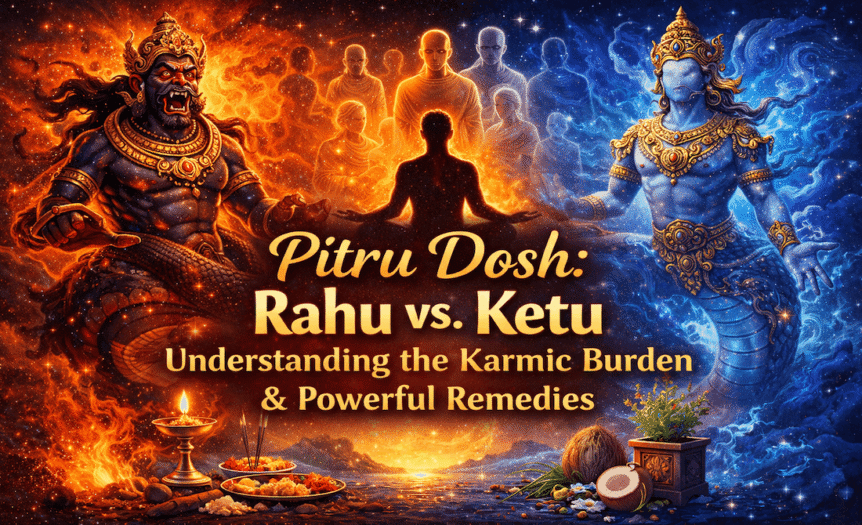
Astrologically, Pitru Dosh is often seen when Rahu or Ketu conjunct significant planets such as the Sun, Moon, Jupiter, or Saturn, or when they occupy certain critical houses. Although both Rahu and Ketu can create Pitru Dosh, the nature of their influence differs significantly.
In India, it has become a common trend to associate Pitru Dosh with expensive rituals and elaborate pujas costing thousands of rupees. But remember, the most beautiful and powerful remedies are never expensive. Love is not expensive. God is not expensive. Truth is not expensive. Simplicity is divine. It is the mind that complicates what is essentially simple. True remedies involve conscious karmic correction and sincere spiritual practice, not merely one-time rituals.
Pitru Dosh arises when ancestral karmic debts remain unresolved and the unfulfilled desires or mistakes of forefathers continue to affect future generations. Rahu and Ketu are both linked to past-life karma, but they create Pitru Dosh in different ways when they conjunct key planets or occupy certain houses.
Rahu represents desire, illusion, and intense material cravings carried from past lives. When Rahu joins important planets such as the Sun, Moon, or Jupiter, it may indicate ancestors who had strong unfulfilled material desires related to wealth, power, status, or family success and could not attain peace after death. Their unresolved cravings remain attached to the lineage, manifesting as financial, emotional, or spiritual struggles in descendants.
Common effects of Rahu-related Pitru Dosh include persistent financial instability despite hard work, unstable career paths, repeated failures, legal complications, recurring family conflicts, strained paternal relationships, mental stress, anxiety, addictions, difficulties in childbirth, strained relations with children, and obstacles in spiritual growth.
Certain Rahu conjunctions strongly indicate Pitru Dosh:
- Rahu–Sun conjunction (Surya Grahan Dosh) signifies unresolved karma from the father’s lineage and may create ego clashes, lack of paternal blessings, and challenges in career or dealings with authority.
- Rahu–Moon conjunction (Chandra Grahan Dosh) reflects maternal lineage issues, leading to emotional instability, strained maternal relationships, and mental unrest.
- Rahu–Jupiter conjunction indicates spiritual and financial blockage, distorted beliefs, unethical tendencies, or financial setbacks due to karmic influences.
- Rahu placed in the ninth house is one of the strongest indicators of Pitru Dosh, as it directly affects ancestral blessings, higher guidance, and dharma.
Simple remedies for Rahu-related Pitru Dosh include lighting a mustard oil lamp under a Peepal tree on Saturdays, offering water to the Sun daily (Surya Arghya), chanting Vishnu mantras 108 times every morning and evening using a sacred mala, donating groundnut oil on Saturdays at a Hanuman temple, reading sacred texts such as the Vishnu Purana, and wearing a nine-mukhi rudraksha bead with proper guidance.
Ketu, on the other hand, represents detachment, spiritual depth, and unresolved past-life karmas. When Ketu forms significant conjunctions, it indicates ancestors who may have neglected their duties, faced unnatural deaths, or remained spiritually unfulfilled. Ketu-related Pitru Dosh manifests more on the emotional and psychological plane rather than purely material struggles.
Effects of Ketu-related Pitru Dosh include emotional detachment, isolation, broken family bonds, unexplained health issues, sudden accidents, difficulty in having children, strained relationships with offspring, spiritual confusion, lack of faith, anxiety, and a deep sense of not belonging. Rahu-related Pitru Dosh primarily impacts material growth, whereas Ketu-related Pitru Dosh impacts emotional and mental stability.
Key Ketu conjunctions include:
- Ketu–Sun, indicating paternal karmic burdens and weak fatherly support.
- Ketu–Moon, which can create emotional instability but also enhance spiritual detachment if the individual walks a spiritual path.
- Ketu–Jupiter, reflecting karmic burdens related to misuse of dharma or spiritual knowledge in past lives, affecting education and wisdom.
Significant Ketu house placements include Ketu in the first house (life-direction challenges), fifth house (issues related to children), ninth house (loss of ancestral blessings), and tenth house (career setbacks due to karmic debts).
Remedies for Ketu-related Pitru Dosh include offering prayers to ancestors on Amavasya, chanting “Om Namah Shivaya” 108 times daily, visiting a Shiva temple regularly, performing abhishek with water, milk, and honey, donating black sesame seeds, blankets, or wall clocks to the needy, offering water to Peepal and Banyan trees, and wearing a ten-mukhi rudraksha bead with proper guidance.
Among all remedies, consistent mantra chanting and karmic correction through righteous living remain the most powerful.
One of the simplest and most profound remedies for Pitru Dosh is feeding curd and rice to crows. The crow holds deep symbolic significance in Hindu tradition and is associated with ancestors and Lord Shani. The more lovingly and respectfully you feed crows, the more ancestral obstacles begin to dissolve.
It is fascinating that modern science now acknowledges the crow as one of the most intelligent birds after humans. Perhaps our ancient seers and sages understood this truth long ago. In Hindu rituals after death, food is offered to crows, and if a crow accepts the offering, it is believed that the departed soul has progressed in its journey.
When you see a crow, fold your hands with gratitude. Offer food when possible. Simple acts performed with sincerity hold immense power.
Pitru Dosh is not a curse to fear but a karmic responsibility to resolve. Through mantra, charity, right action, and conscious living, ancestral burdens transform into ancestral blessings.
Jai Shri Ganesha. Jai Guru.

(Astrologer, Spiritual Guide & Rahu–Ketu Specialist)
Acharya Addittya Tamhankar is a widely respected astrologer, spiritual guide, and Rahu–Ketu specialist known for his deep understanding of karmic astrology and practical spiritual insight. With more than two decades of experience in Vedic astrology, he has guided thousands of individuals across the world in matters related to career, marriage, relationships, health, finances, emotional struggles, and life direction.
Renowned for his powerful Rahu–Ketu analysis and his ability to simplify complex astrological principles into practical and meaningful guidance, Acharya Addittya has emerged as one of the most recognized contemporary voices in astrology. His work combines traditional Vedic wisdom with a modern, grounded approach that resonates deeply with today’s seekers.
A bestselling author of 13+ books and recipient of multiple national honors, his contributions to astrology and spiritual awareness have been featured in reputed publications and recognized on prestigious platforms. Through his writings, consultations, podcasts, and teachings, he continues to inspire people to understand their karmic patterns, make wiser decisions, and move through life with greater clarity, strength, and confidence.