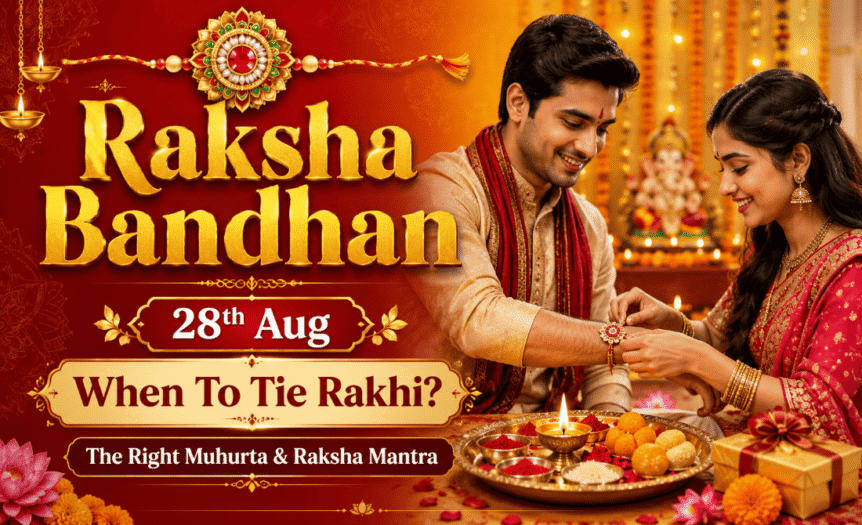
On 28th August 2026, India will celebrate the beautiful festival of Raksha Bandhan.
But something unusual is happening on the very same day.
There is also a Partial Lunar Eclipse.
So naturally, many people are asking:
Can we tie Rakhi on 28th August?
What is the correct Muhurat?
Will Sutak apply?
And most importantly — what if I tell you that Raksha Bandhan was never limited only to a sister tying a Rakhi on the wrist of her brother?
Because the real word is not merely Rakhi.
The real word is—
RAKSHA.
Protection.
And wherever there is genuine love, protection, blessing and responsibility, there can be a sacred bond of Raksha.
WHAT ABOUT THE LUNAR ECLIPSE?
Yes, a Partial Lunar Eclipse occurs on 28th August 2026, with its maximum phase at approximately 9:43 AM IST.
But remember something very important:
This Lunar Eclipse will NOT be visible from India.
And according to the traditional Panchang principle, when an eclipse is not visible from your location, the religious Sutak restrictions are not observed there.
So there is no need to become unnecessarily afraid.
I always say:
“Dharma should remove fear from your mind; it should never become another reason for creating fear.”
WHAT IS THE RAKHI MUHURAT?
The Shravana Purnima Tithi begins at approximately 9:08 AM on 27th August and ends at approximately 9:48 AM on 28th August.
Bhadra gets over before sunrise on the 28th.
Therefore, my practical advice for people across India is:
Tie the Rakhi after your local sunrise and complete the ceremony before 9:48 AM on Friday, 28th August.
Since sunrise varies from city to city, simply check your local sunrise.
The important point is:
Complete the Rakhi ceremony peacefully before 9:48 AM.
WHAT DOES RAKSHA BANDHAN REALLY MEAN?
Raksha Bandhan essentially means a—
bond of protection.
The brother-sister relationship is its most popular expression today, but the spiritual idea of Raksha is much older.
Ancient traditions speak of sacred protective threads or amulets being tied on Shravana Purnima.
And one powerful story associated with the Bhavishya Purana explains this beautifully.
INDRA AND SHACHI — THE ANCIENT RAKSHA VIDHAN
According to this tradition, there was once a prolonged battle between the Devas and the Asuras.
The Devas were defeated and Indra lost his kingdom.
When his own strength was no longer enough, Indra did something very important.
He went to his Guru.
Guru Brihaspati advised him to perform a sacred protective ceremony called Raksha Vidhan.
On Shravana Purnima, a sacred Raksha was energized through Mantra, prayer and Sankalpa.
And then Shachi — Indra’s wife — tied this sacred Raksha to him.
Indra returned to battle and eventually regained his kingdom.
Now observe the most important point:
Shachi was Indra’s wife. She was not his sister.
That itself reveals the deeper meaning of Raksha Bandhan.
Raksha is not merely about biological relationships.
It is about one person sincerely praying for the protection and wellbeing of another.
A sister can protect a brother.
A brother can protect a sister.
A mother protects through prayer.
A Guru protects through wisdom.
A friend can protect through timely advice.
And a spouse can protect through love and support.
Therefore:
“Those who truly love each other become protectors of each other’s wellbeing.”
That is Raksha Bandhan.
WHAT MAKES A RAKHI SACRED?
The sacred Raksha of Indra was first energized through prayer and Mantra.
So what made it powerful?
Not merely the thread.
It was the Sankalpa behind the thread.
The prayer.
The faith.
The love.
The Mantra.
The physical thread is simply the visible symbol of an invisible prayer.
An expensive Rakhi without love remains an ornament.
But even a simple thread tied with genuine prayer becomes spiritually priceless.
ENERGIZE YOUR RAKHI WITH MANTRA
Before tying the Rakhi, place it for a few moments before your Ishta Devata.
Light a lamp.
Close your eyes.
Think of the person for whom you are praying.
And make a sincere Sankalpa.
The traditional Raksha Sutra Mantra is:
ॐ येन बद्धो बली राजा दानवेन्द्रो महाबलः।
तेन त्वामभिबध्नामि रक्षे मा चल मा चल॥
Om Yena Baddho Bali Raja
Danavendro Mahabalah,
Tena Tvam Abhibadhnami
Rakshe Ma Chala Ma Chala.
Its essence is:
“Just as the mighty King Bali was bound by the sacred Raksha, I bind this Raksha upon you. O sacred protection, remain firm. Do not waver.”
You may chant this 11 times.
According to your devotion, you may also chant any one protection Mantra:
Mahamrityunjaya Mantra for Lord Shiva.
Om Dum Durgayai Namah for Maa Durga.
Om Ham Hanumate Namah for Lord Hanuman.
Or—
Om Namo Bhagavate Narasimhaya for Lord Narasimha.
You don’t have to chant everything.
Remember:
Mantra is not mathematics.
What matters is your Bhava, faith and Sankalpa.
And while tying the Rakhi, think:
“Through this Raksha Sutra, I pray that Divine Grace protects you wherever my own hands cannot reach.”
RAKSHA CAN ALSO BE SPIRITUAL
A true Guru protects you from ignorance, wrong decisions and the wrong path.
That too is Raksha.
I always say:
“The person who only pleases you may become your companion. But the person who saves you from your own ignorance becomes your Guru.”
And the greatest way to honour your Guru is not merely by offering flowers or a thread.
It is by living the teaching.
The greatest Guru Dakshina is transformation.
Similarly, devotees may offer a Raksha Sutra to their Ishta Devata.
But there is a beautiful paradox here.
We may think that we are tying Rakhi to God.
Yet spiritually—
God has already tied an invisible Rakhi around us.
THE INVISIBLE RAKHIS OF LIFE
Not every Rakhi is visible.
Your mother’s prayer can be a Rakhi.
Your father’s sacrifice can be a Rakhi.
A Guru’s warning can be a Rakhi.
A friend’s advice can be a Rakhi.
Sometimes even a rejection protects you.
A delay protects you.
A closed door protects you.
And sometimes God says NO because He can see what you cannot.
You may ask today:
“Why didn’t God allow this?”
And years later say:
“Thank God it never happened.”
That too was Raksha.
HOW I SUGGEST YOU CELEBRATE
On the morning of 28th August:
Take your bath.
Wear clean clothes.
Light a lamp before your Ishta Devata.
Place the Rakhi before the deity.
Chant the Raksha Sutra Mantra 11 times.
And complete your Rakhi ceremony before 9:48 AM.
While tying it, make one inner Sankalpa:
“May I protect those who trust me.
May I protect the dignity of those I love.
May I protect my Dharma.
And may God protect me from dangers that my own eyes cannot see.”
Because Rakhi should not remain merely a ritual.
It should become a prayer.
A promise.
A Sankalpa.
I want to leave you with one powerful symbolic story connected with Raksha Bandhan.
Read carefully.
Because this story reveals what happens when a simple thread becomes stronger than power, ambition — and even a weapon.
ONE POWERFUL SYMBOLIC STORY
Alexander the Great conquered the frontier land of India. The man who was fighting him was a man of immense insight and immense power – but not physical power. Alexander had a bigger army, more developed techniques of destruction.
Poras – that was the name of the man who ruled on the boundary of India – was really a brave man. His very name “Poras” means a real man, an authentic man. And Alexander, for the first time, was afraid; although he had more armies, he did not have that spiritual quality that Poras had, that meditativeness, that presence.
Alexander had heard many stories about Poras: nobody has ever been able to conquer his land although bigger armies have attacked it. The man has something in him, so that his very presence makes his army ten times bigger. His people feel that their victory is certain because Poras is leading them, and Poras knows no defeat.
Alexander was, for the first time, trembling inside, and for the first time he behaved as a politician – ugly. Up to that point he had simply been a great warrior, but hearing about Poras, he thought, “He is a far greater warrior, not only physically but spiritually; and just an army won’t do.” So Alexander played a cunning strategy.
In India, in the month of Shravan in the rainy season, there is a day, the day of brothers and sisters.
The sister binds a thread to the brother’s wrist. It is called rakshabandhan, a contract that “You will protect me.” The brother promises her that even if he has to lose his life he will protect her.
And Alexander sent his wife on that day to the palace of Poras. Of course she was received with great honor. Everybody was surprised that she had come, because on the other side of the Sindhu River Alexander was waiting for the right time to attack. And his wife came alone. She said, “I want to see Poras.”
Poras had no sister. She went to Poras and she said, “You don’t have any sister; I don’t have any brother. I want to become your sister.” And she had brought the traditional thread.
She put the thread on the wrist of Poras, and Poras touched the feet of the woman and said, “You need not be afraid of anything. As long as I am alive I will protect you. If you want to ask for anything that I can give to you, I will be honored.” And she said, “In the war that is going to happen please don’t kill my husband; he is your brother-in-law. You will be destroying my lover. Remember this thread. You have promised to protect me.”
Poras could see the strategy, but he was a man of his word. He said, “Don’t be worried.” And she was sent with security so that she could reach her camp on the other side.
And this was the reason that Poras was defeated. History books written by Westerners simply don’t mention the fact; it was not a victory for Alexander, it was a victory for Poras.
There came a time when Poras attacked Alexander, and Alexander fell from his horse. Poras was on his elephant – Indian armies fought on elephants – and he was just going to kill Alexander when he saw the thread on his own wrist. The spear that was going to kill turned back in a second, and Poras said to Alexander, “I cannot kill you. I have promised your wife that I will not harm anything that harms her, that I will protect her.”
This was the reason that Poras lost the war. But Alexander still could not understand, because he could not understand the way of the East, that Eastern people have been thinking in totally different terms. It was really a spiritual victory, a great victory for Poras.
Poras was brought in chains, handcuffed, into the court of Alexander, but he came there like a lion – of course encaged.
And this is the sentence that I want you to understand. Alexander said to him… Remember that this man Poras is certainly rare: his spear had reached just near Alexander’s heart; one second more and he would have been dead, and he pulled it back because of a promise given to an unknown woman.
Alexander asked Poras, “How do you want to be treated?”
Poras laughed, and he said, “I should be treated as an emperor is treated by another emperor.”
There was silence in the hall. In Alexander’s court they had never heard such a thing – that a king who has been enslaved should laugh and say, “There is no question. You should have learned manners. An emperor should be treated as an emperor.”
For a moment Alexander was indecisive, but then his better self came over him. He remembered, because seeing on the wrist of Poras the same thread… It was still there; it is not removed until it falls off by itself.
He told the people, “Make him free. Give his kingdom back to him. And we cannot go deeper into India. It is dangerous. If on the frontier this episode happened, what will happen in the interior parts we don’t know. We are going back. It is enough that we have conquered.”
THE DEEPER MESSAGE
A thread stopped a spear.
But actually, it was not the thread.
It was the promise behind the thread.
Poras had the power to kill Alexander, but he remembered the word he had given.
And that is the real test of Dharma.
A promise is easy when keeping it costs you nothing.
A promise becomes sacred when keeping it demands sacrifice.
Externally, Poras may have lost the battle.
But spiritually, was he defeated?
No.
His hands could be chained, but his conscience remained free.
And notice something else.
Alexander’s wife was not Poras’s biological sister.
Just as Shachi was Indra’s wife and not his sister, once again Raksha goes beyond blood relationships.
So this Raksha Bandhan, don’t merely ask:
“Who will protect me?”
Ask:
“Whose trust am I protecting?”
Am I protecting my word?
My relationships?
My Guru’s teachings?
My Dharma?
And above everything—
am I protecting my own conscience?
Because the deepest Raksha is protection from becoming someone who betrays his own values.
Our ancient wisdom says:
Dharmo Rakshati Rakshitah.
Dharma protects those who protect Dharma.
So when somebody ties a Rakhi around your wrist, remember:
Rakhi is a thread.
Raksha is a promise.
Bandhan is responsibility.
The world may admire the person who conquers others.
But spirituality celebrates the person who can conquer himself.
Poras had the strength to raise the spear—
but he had something greater:
the consciousness to lower it.
So don’t merely pray:
“May someone protect me.”
Also pray:
“May God make me worthy of the trust that others place in me.”
May I protect my word.
May I protect my Dharma.
May I protect those who depend upon me.
And where my strength cannot reach—
may Divine Grace protect me.
Because ultimately—
the strongest Rakhi is not the thread tied around your wrist.
The strongest Rakhi is the Dharma tied around your heart.
Wishing you and your family a blessed and spiritually meaningful Raksha Bandhan.
Jai Shri Ganesha. Jai Guru.
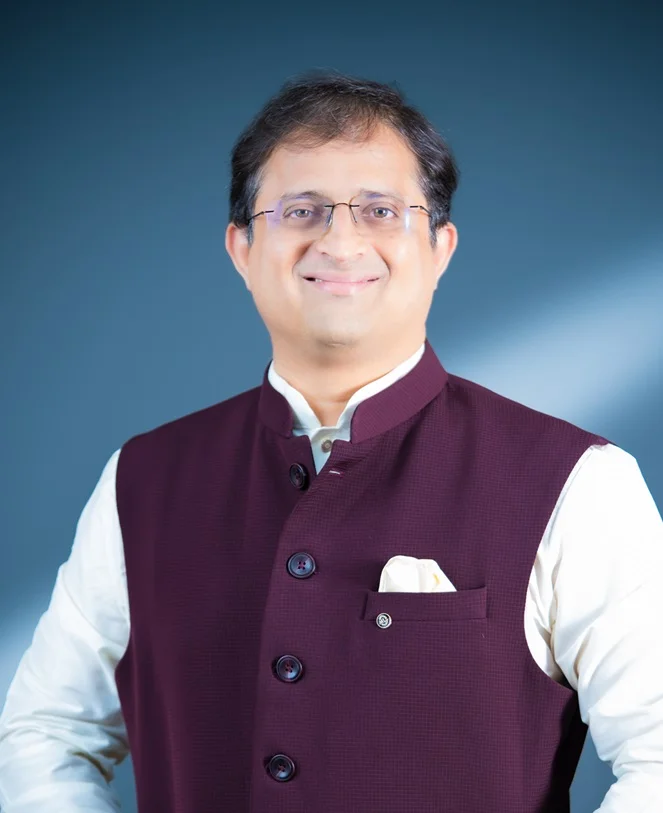
(Astrologer, Spiritual Guide & Rahu–Ketu Specialist)
Acharya Addittya Tamhankar is a widely respected astrologer, spiritual guide, and Rahu–Ketu specialist known for his deep understanding of karmic astrology and practical spiritual insight. With more than two decades of experience in Vedic astrology, he has guided thousands of individuals across the world in matters related to career, marriage, relationships, health, finances, emotional struggles, and life direction.
Renowned for his powerful Rahu–Ketu analysis and his ability to simplify complex astrological principles into practical and meaningful guidance, Acharya Addittya has emerged as one of the most recognized contemporary voices in astrology. His work combines traditional Vedic wisdom with a modern, grounded approach that resonates deeply with today’s seekers.
A bestselling author of 13+ books and recipient of multiple national honors, his contributions to astrology and spiritual awareness have been featured in reputed publications and recognized on prestigious platforms. Through his writings, consultations, podcasts, and teachings, he continues to inspire people to understand their karmic patterns, make wiser decisions, and move through life with greater clarity, strength, and confidence.